Ankara’s ribs
· PLD Türkiye
Automatically translated from Turkish. Read the original
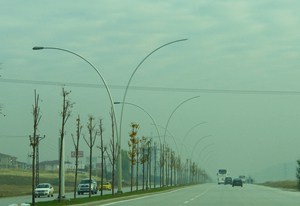 The story goes that a “very” senior official at the Ankara Metropolitan Municipality, on a visit to Kuala Lumpur, comes across some lighting poles they like a lot. The official comes home with one idea: “We should use these modern-looking lighting poles in our capital, Ankara, too.” And so the project enters the city limits. No problem so far. But what happened next is a great mystery, because the process is run in such a way that when you look at the results, you are left somewhere between laughing and getting angry. The result is very clear: a disaster that happened while bringing a trend the world follows to Türkiye…
The use of aluminium in lighting poles and flagpoles keeps growing around the world too. Its strength, easy installation, light weight, the way it takes different surface finishes, and its long life (its resistance to corrosion) give it very big advantages over the galvanised steel and concrete poles in common use. These products can be made in Türkiye too. So I am not questioning whether the choice was right. It started from a very good point. But in the implementation, the mistakes were so big that you cannot miss the fact that nobody managed the process professionally. And once again it shows how important it is for municipalities to have expert lighting teams on their staff.
I went back to Ankara, both to see it on site once more and to take some photos. To give you a sense of the project's size, I should share one fact: with the Eskişehir road, the road to Esenboğa airport, and works still going on at different points in the city, we are talking about roughly 3,500 to 5,000 lighting poles. And so far only 2 of Ankara's entrances are done. Once it spreads to all the entrances, the number will reach 20,000. I talked about this with many people in different settings. I want to share with you the problems I saw and could pull together.
 Design:
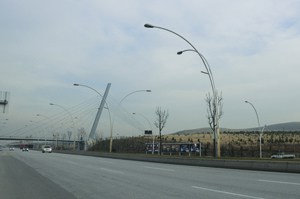
With their aluminium structure, the poles look very modern. The curves look stylish at first, but you can tell nobody studied the project closely enough on the technical side. Across most of the project, the luminaires reach over two lanes of the road they light. This makes the maintenance that has to be done from time to time very hard. On a three-lane road, closing two lanes for maintenance is dangerous for both traffic and people's safety. Also, because of problems during installation, the poles are out of line. You can see that some stand further out, or the other way round, further in, and they do not form a straight line.
 Lamp use:
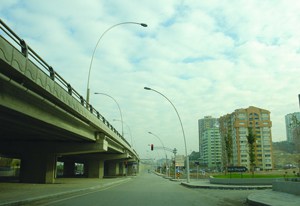
Going round the project, you can't help getting this feeling. It is as if some facts came to light as the project went on, and people made changes to fit them. For example, the luminaires on the Esenboğa airport road are fitted with 600 Watt, but elsewhere they are not. Also, the luminaires in this section can take 400 Watt at most, yet 600 Watt lamps went in, so their ballasts did not fit in the luminaire. They were put in the cover compartment at the bottom of the pole instead. That means 12 to 13 metres between ballast and lamp, and a voltage drop over that distance, which shortens the lamp's life. This mistake pushes up maintenance and running costs, one of the biggest costs of all. And on top of that, there is the danger of roads left dark when nobody does regular maintenance and repair.
Vandalism:
It looks as if nobody took any measure against vandalism. I saw many poles with their covers stolen. Sadly, they stand there with the covers open and the electric cables hanging out, a very big danger.
Quantity:
For modern road lighting on ME1, ME2 class roads, the C.I.E standards point to 45 to 50 metres between two poles. (Provided you use quality luminaires that meet the standards and have a high protection class.) In Ankara, the spacing we see is 27 to 30 metres. So you can't help thinking that they used more poles than needed. Another sign is the pointless pedestrian lighting poles… They are even in areas pedestrians do not use! It is so funny: some of them are left switched off, because the billboards right next to them already light the area enough. Or, as on the Eskişehir road, separate lighting poles went up just for a single-lane road where shuttles and public transport drop off and pick up passengers, which makes no sense at all. The logic "the bigger the project, the better" shouts at you from every corner. Even though I want to keep my good faith, I can't help being surprised. It is as if either nobody did any calculation, or somebody did it with very bad intent.
 Technical:
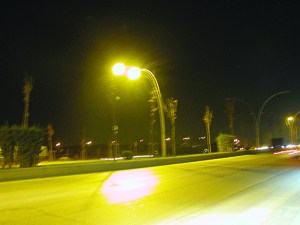
I could give examples one by one, but in general we see a zebra effect across the project. That is, many drivers pass through light and dark areas, one after the other. This is a big danger for driving safety. It is the perfect setting for drivers both to lose focus and to fall asleep. There are also areas with glare, and spots in the middle of the road where the light bursts out like a floodlight. The funniest part, and I still find it hard to understand: as you go round, you see some poles standing in senseless ways. Ones that have ended up side by side, ones at an absurd angle, and so on. This comes from mistakes the installation company made when anchoring the poles. In strong winds the anchor wedges break, and the poles shift direction and position with the wind. They say maintenance crews find and fix poles like these around the city almost every night. Maintenance costs go up too.
As I said, these are the things that caught my eye on my short trip… A deeper study could bring up other problems too. In short, the oddities in this project are endless. How did such an important project of a city, and the country's capital at that, end up like this? I think the whole process needs a new review from start to finish. Let it be reviewed, so that nobody makes such grave mistakes again.