Consulting
I help lighting manufacturers put their product data in order with a PIM (Product Information Management): a single source of truth.
For lighting manufacturers who still update their data by hand.
If your website, datasheets and price lists still come out of Excel files and manual work, this page is for you. I work with several lighting manufacturers on 4 continents: North America, Australia, Asia and Europe.
Manual M carries the data by hand. Then the supplier changes the driver, and every sheet in the pile has to change too. Automated A changes one record, and the rest follows. In your company, who carries the pile?
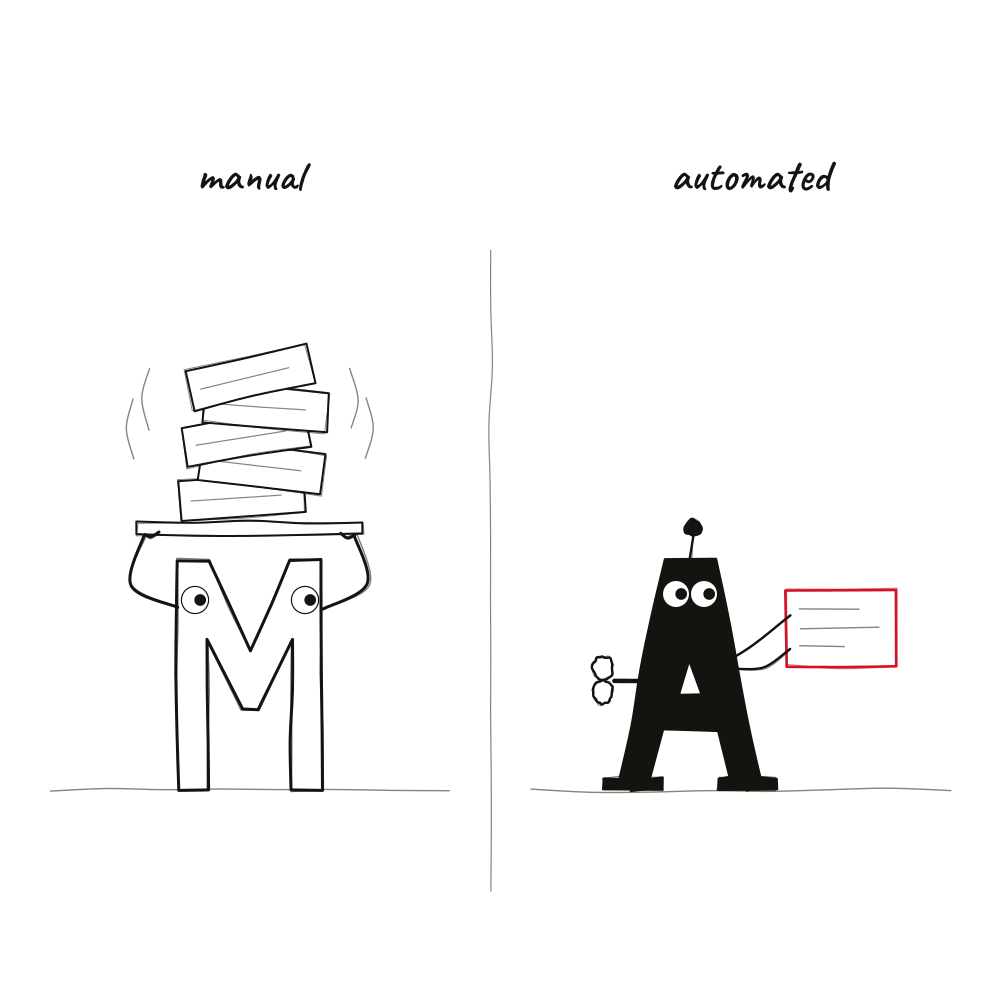
Lighting data is hard. Excel and manual work can't keep up.
Take one luminaire. It carries dozens of attributes and needs many files: datasheets, installation manuals, IES and LDT files, CE documents. Multiply that by every language and a version for each market. Then the supplier changes the driver. Every one of those files, and the website, has to change too.
PIM Steps: from the first call to launch, in five steps.
Step 0 takes about 2 months. Steps 1 to 4 take 3 to 6 months.
- Proposal. First I learn the project. Where does the data come from: manual updates, Excel, or your CRM or ERP? Where should it go: the website, datasheets, catalogues, installation manuals? Who will I work with? How many products and languages are there? Then I propose a solution, with a budget and a timeline.
- Discovery. Once you sign, I work closely with your team and define the project in detail. Phase 1 stays close to the bare minimum: the website and the datasheets. If the base is weak, everything after it gets harder.
- Data structure. I design the data structure and write a brief for each output. Sometimes the product ordering logic needs a rewrite too. At B-K Lighting, I did that rewrite myself, after two factory visits.
- Coding and data entry. The coding team builds the integrations and the outputs from the briefs, on sample data first. At the same time, your team enters the full catalogue. This is often the hard part, so I stay close.
- Launch. The website and the datasheets go live, and Phase 1 closes. It's often a proud moment. It's also when you start to see the return. Then most clients look at the next manual process: price lists, installation manuals, catalogues, BIM files.
I own the project, from Step 0 to launch.
I don't sell a tool and walk away.
- Data structure
- I design it. When the old product ordering logic doesn't hold, I rewrite it.
- Responsibilities
- We agree who enters which data, who approves it and who holds the technical information.
- Vendors
- I manage the PIM vendor and the coding team. If a vendor slows the project down, I say so and propose a change.
- The project
- The schedule, the meetings, the decisions, and training for your team along the way.
- The record
- Every project runs in its own Basecamp project from day one. Every decision, file and meeting note sits there, and you keep it. A new team member reads the history instead of asking around.
What it costs, and who gets paid.
The budget has three parts.
The PIM licence
The annual Sales Layer subscription, at Sales Layer's own price. It costs you the same when you work with me.
The coding
Paid to the team that builds the integrations and the outputs. If you have your own coding team, this part goes to zero. A team with no PIM experience can slow the project down, though.
My fee
For the project work only. I take no cut from coding vendors, so my advice has no hidden reason.
You see the figures in the Step 0 proposal.
Results
B-K Lighting, a US outdoor and landscape lighting manufacturer
Before PIM, the technical data sat in Excel, the website was updated by hand, and the spec sheets and price sheets were InDesign files. Now the website, the spec sheets and the price sheets all come from the PIM. In December 2025, a big price update went through in a couple of days. Before PIM, the same update took a couple of months.