LEDs and colour: Is every building a disco now?
· PLD Türkiye
Automatically translated from Turkish. Read the original
LEDs have been in commercial use since as far back as the 1960s. The blue LED came in the early 1990s. But LEDs really entered our lives through general lighting in 2008 and the years after. Small size, long life and easy colour change let them quickly catch up with every other light source, and today they are close to a monopoly. OLED, which has not settled yet, and laser, which is still developing, stand as threats. Even so, we have to accept that all conventional light sources are behind us now. Today, when people hear the word lighting, they think of LED.
I wrote about the effects of the lawlessness and the lack of standards that this fast change brought in this article. (See: The wild west, or the lighting industry after LED). Today I want to take a close look at the relationship between LEDs and the use of colour.
Hardly a day goes by without another historic façade on the city skyline renewing its lighting and putting on a show of colour. This transformation, "out of context and baseless" to put it most politely, and in truth carried out quite mindlessly, comes in every size, from a single façade to a whole district. On this subject, the Kuzey Yıldızı park in Ankara's Pursaklar district has already earned its place in history as an unbelievable example. Grandpas with BIM supermarket bags cracking sunflower seeds under pink-lit pergolas, or the torment people go through every night with red light shining into their homes: believe me, I can't quite decide which is stranger. I also take it as one of life's little ironies that these are called "decorative" work, and that Ankara was once even the subject of a lighting award for them. The article I wrote on this, which even ended all our business with an international lighting manufacturer, is still relevant. (See: An Ankara tale…)
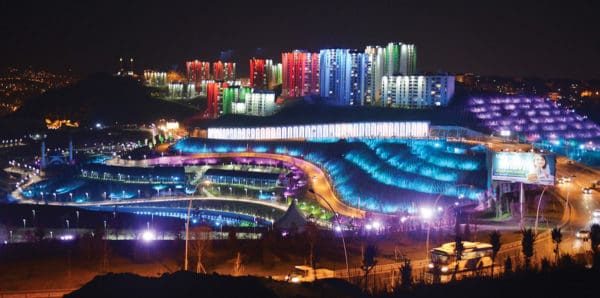
Lighting design draws on many disciplines. Under normal conditions, the design process should grow out of the input of different disciplines such as physics, electricity, psychology, health and sociology. In this sense, any approach that ignores the relationship between colour and culture feeds the "mindless" transformation I mentioned.
Colour and culture
A colour does not mean the same thing in every culture. How it is used, and what it calls to mind, differ from one culture to another. To take the simplest case, green does not mean the same thing in a region with Muslim roots as it does in America. Or look at the clear effect of the seasons on the choice of colour temperature. Northern Europe mostly likes warm white (2700K, 3000K), while the Middle East may prefer cool white (4000K, 5000K). Some cultures, like Iran, even use 3000K and 4000K side by side in the same luminaire. These preferences form over time. When we come back to the case of Türkiye, too much colour, that is, many colours used together and in motion, has a clear cultural meaning: "pavyon" (the seedy Turkish nightclub). As it came up during the lighting of İstanbul's Bosphorus Bridge, most of us think of this word the moment we see lots of colour. In the Far East, on the other hand, colours are woven into the culture and accepted.
Context
And even if you accept the risk of the "pavyon" label and decide to use colour, you must answer one very important question. Why? Why do you use those colours, with that animation? This question is not special to lighting. Whatever the discipline (architecture, graphics and so on), every design decision you make should have an answer to "why". But the risk here makes it even more important. Sadly, most of the time the answer is: because "the LED can change colour". So if it can change, why shouldn't it? Right? How very logical!
I know the client makes these decisions most of the time, so when I bring this up, my salesperson and designer friends can say "but the client wants it". They're right. In fact, one story I tell in my talks still makes me laugh. A friend from the technical team of another major, internationally known manufacturer told it to me. They go to a façade project in Azerbaijan. The aim is to present two scenarios they prepared in advance to the client and get approval. A large team, the client included, is waiting. Before showing the scenarios, the friend telling the story first runs a test scenario they use to check that all the LEDs work. The client watches this test scenario, in which every possible colour flashes on and off for 5 minutes with no aim and no context, and says "I love it". After that, however hard they try to explain, and even though they show the other scenarios, the client doesn't change their mind. To this day, that test scenario is still putting on its "show" on that façade.
Control mechanism and a suggestion
In fact, the strangeness of the situation is plain to see. In a place that affects the whole city skyline, the entire decision comes down to the client's say-so. It will stay that way wherever there is no public control. Sadly, our country still has no such control mechanism.
Besides, it's only human to like something flashy and whirling that you see for just 5 minutes. The problem is for the city and the neighbours who have to look at that façade all night. As I said in this article, unless we treat light like sound, that is, unless we set rules for the use of light in public space as we do for sound, this will go on just the same. (See: 3 basic proposals to (largely) prevent light pollution.)
I hope this changes too, once the İstanbul City Lighting Master Plan, which we have been hearing about for a long time, is announced and put into effect.
Until these rules settle, I have a humble suggestion for all my salesperson and designer friends who are sincerely bothered by the process. Please warn your clients. If you can, run these approvals by having them look at the same view all night, not just for 5 minutes. A dinner at a restaurant facing the façade, maybe? Slower transitions, different scenarios after midnight: you can suggest all of these.
Now is the time to act. But only by acting together can we start the change. That way, the ever more colourful life of recent years can calm down a little, and the people forced to put up with this light trespass can suffer a little less. Otherwise we'll all end up asking a new question, and asking it a lot: "Or are you still holding out against the disco?"
Emre Güneş