The Wild West, or the lighting industry after LED
· PLD Türkiye
Automatically translated from Turkish. Read the original
 The Wild West is a term for the sparsely settled "far west" regions of America, especially in the second half of the 19th century. Native American attacks there could not be stopped, and crime rose because the security forces were not enough. In that period no state authority held sway, and anyone could set up law and order “as they pleased” or do business without any standard. Since then, "Wild West" has become a label for any place or period that is out of control and dangerous.
For the lighting industry, which we can now call almost nothing but "the LED industry", "Wild West" is a perfect description. No rules, no order, no standards, no one checking. Nothing, nothing, nothing.
LED clearly deserves "disruptive", the adjective people now use mostly for internet-based technologies. LED technology takes more market share from conventional light sources every day. It developed, and keeps developing, so fast and so out of control that it has already knocked every stone in the lighting industry out of place.
Globally, the market has brought out new component suppliers, especially ones with an innovative approach. At the same time, it has been the stage for lighting manufacturers that appeared with LED and became international brands in a short time. We see some of the big, near-monopoly lighting companies leave the industry one by one in the face of this speed, or at least get ready to leave. Others keep up with the pace of innovation by buying these new companies.
In Türkiye, long-established lighting manufacturers that could not keep up with this change have shut their doors. Investors with no link to the industry (supermarket owners, textile makers and so on) have become lighting manufacturers. Component suppliers have turned into luminaire manufacturers, ad and sign makers into luminaire manufacturers too, and magazine people into component suppliers (don't worry, I'm pointing this one at myself). We have entered a period where everyone is changing identity.
The cards are being dealt again, you may say, and that's normal. But the problem isn't only the number of players springing up like mushrooms, the falling profit margins or the uncertainty. The problem is the dust storm kicked up by the gap between the speed of the switch to LED and the pace at which standards form. The dust is so thick that when you calm down for a moment and think, you can't be sure whether this change brings benefit or harm.
What do I mean by standards forming? Don't tell me an industry this big must have standards. It doesn't. To explain, let's first look at what changed in our lives with LED.
With the old, conventional technologies (halogen, metal halide, sodium vapour, fluorescent, CFL and so on), the world's giant monopolies made lamps to a set standard for each lamp type. A handful of brands, fewer than the fingers of one hand, made these products, and they shared a standard in cap, size, electrical properties and so on. In the old days, when you bought a 50W, 25-degree halogen lamp, you knew what you were getting (even if very small differences were possible). (By the way, let me mention here that these companies came together in the 1920s and formed the world's first monopoly. But I'll save that story for another article.)
Today, you can't say that about LED light sources. If you're far from the subject, I can almost hear you ask “what do you mean?”
WARNING: From here on, I'll talk a lot about technical terms and concepts written with 3 or 4 letters and numbers. My aim is never to confuse you. Quite the opposite: I want to show how complex the subject has become. I also plan to write a separate article on each of these concepts you need to know. Anyway, let's go on.
Here's what I mean: picture 2 track spotlights with LED light sources.
Say both catalogues list 3000K (kelvin, colour temperature), 80 CRI (colour rendering), 10W (watts) and 25 degrees. You'd expect the 2 products to perform about the same, right? Sadly, no.
Example:
https://twitter.com/eugene_andre/status/892127633256873984
- As the designer protests above: same colour temperature, same angle, but a very different result.
Now let's look at the specs one by one:
Colour temperature:
3000K really means a value within a certain range around 3000K. So, depending on the manufacturer, the product may sit anywhere between 2600K and 3400K. You can only get an idea of that range from the MacAdam ellipse value (sensitivity to white). (It's also written as SDCM. This concept needs a longer article to explain, and it's not today's subject. For those who want the short version: expect, or ask for, 3 MacAdam ellipses at most. That's a range of about 150K, a difference our eyes can't see in many applications.)
Colour rendering:
80 CRI (colour rendering index), in the simplest terms, is an artificial light source's ability to reproduce colours, scored out of 100. So at its core, this product shows colours 80% correctly. "Correctly" here means how well the product brings out colours compared with a reference light source. (Reference light source: incandescent and halogen lamps for 2700K and 3000K, daylight for 5000K.)
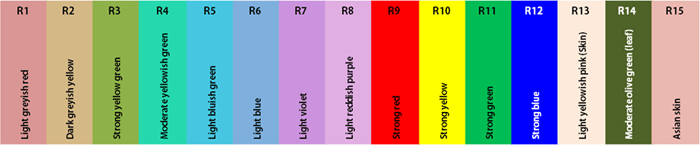
But the CRI calculation, to put it most simply, is meaningless for LED. (Don't get angry, I'll explain it in more detail in another article.) It still meant something for the old standard technologies, but it lost its meaning with LED. For now it's calculated from 8 pastel colours and written as Ra. You can learn about the 7 important colours added later (especially R9, the deep red value, an important wavelength that gives every colour its sparkle) only from certain manufacturers. Then it's written as Re, and it's the average of 15 colours. The TM-30-15 standard, which the IES (Illuminating Engineering Society of North America, sometimes shortened to IESNA) in America brought out last year, hasn't caught on. I'll try to explain that too in the article on CRI. Before TM-30-15, helper tools for CRI such as CQS (Color Quality Scale) and GAI (Gamut Area Index) also appeared, but none of them caught on.
Light output:
With LED, the 10W on the label tells you only, and only, the power it uses. Lumens are a more correct way to state output. But even that isn't enough. Say both products list 1000 lm (luminous flux, light output). The first question to ask is whether this value belongs to the light source or to the luminaire. For a long time, the whole industry gave the light source's lumen value in its catalogues. (Many still do.) But once the light source goes into a luminaire, the reflector, lens and driver (the total system loss) cut the light that comes out. Some designers and end users who learned about this started to ask “isn't this the luminaire output?” Besides, if we're talking about directed light, we should look at candela values, not lumens, but I won't go into more detail here. In the end, how many consumers or designers really know the subject is a question mark. Two big German companies even went to court over this. (See: http://www.aydinlatma.gen.tr/katalogda-belirtilen-isik-akisi-dava-konusu-oldu.html)
Beam angle:
25 degrees shows the luminaire sits between a narrow and a medium beam. Technically, you could call it the area where the luminous flux drops to 50%. But it tells you nothing about how even the light pool will be. The pool may not be a perfect circle. You may get shapes like butterfly wings. Or it may not be even, in either intensity or colour temperature. A product that is 4000K in the middle may slide to warm white, 3000K, toward the edges, or turn fully yellow. Or the part called "spill light", which should spill over by 10% at most, may cover far more area than it should.
These concepts are data on the product's light quality.
Luminaire Life:
Now say it also lists a life of L70 > 50,000 hours. To talk about this concept, we first have to look at what it is. (Yes, you guessed right: another article.) At its base, it rests on a standard, again from the IES. The IES says: the LED chip manufacturer publishes a report called LM-80. The LM-80 report shows how the chips perform at 25 degrees ambient temperature, in other words in a lab, at 3 different solder point temperatures (the solder point is where the chip joins the PCB). The LM-80 report gives values for 6,000 to 10,000 hours. Then another standard, called TM-21, projects this value into the future. L70 estimates the hour at which the LED chip's luminous flux (lumens) falls to 70%. The estimated hours can't be more than 6 times the hours actually measured. So if you measure for 10,000 hours, you can estimate a life of 60,000 hours. It also states how much colour shift there may be. (By the way, LM-80 came into our lives in 2008, TM-21 in 2011.)
Notice there's no luminaire here at all. This is data for the light source only. When the luminaire manufacturer puts this chip into its own luminaire design, it estimates or measures what the solder point temperature will be. But we're not talking about a test where all the components come together (driver included). For this, the IES again brought out the LM-84 and TM-28 standards in 2014. Just as with the chip, you can get data for the whole system from test results taken every 1,000 hours. The standard even lets you, instead of 6,000 hours, first run a 3,000-hour system test and calculate the remaining 3,000 hours with LM-80 and TM-21. Luminaire manufacturers, though, rarely go near these tests, because chip and driver products change and improve so often.
Yes, this article really does tangle up far more concepts than it should. But doesn't even what you've just read give you an idea of the part of the iceberg you can't see? My point isn't to run LED down. There's no question that it allows, with endless freedom, very different light applications and solutions. But LED was sold to us as “it flies, it runs, it cuts, it jumps, it's Superman”, and I'm trying to explain that it is a meaningful technology only, and only, in the right hands and with the right application. And the right hands are a competent lighting designer and a reliable lighting manufacturer.
If you too say “oh come on, it's all LED, what's the difference, I'll buy the cheapest” and/or “I need neither a lighting designer nor a good manufacturer. My cousin got into this business, I'll buy from him”, let me remind you that what you're holding is a hand grenade. Under “Wild West” conditions there's no control mechanism either, so when it goes off, don't blame LED like the thousands of consumers before you. Look in the mirror.
Emre Güneş
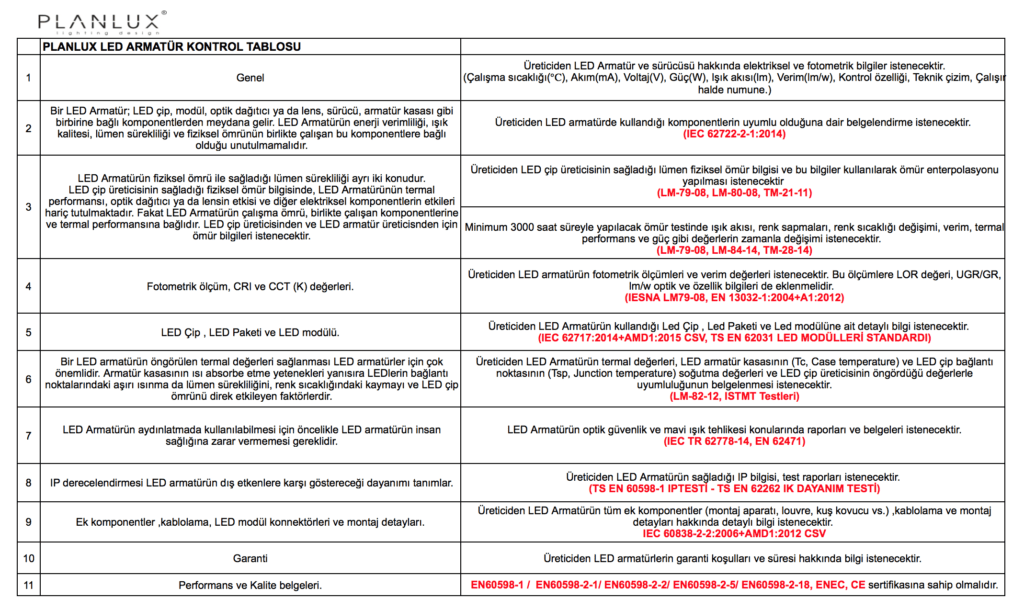
NOTE: Below are the checklists of the lighting design firm Planlux from early 2017. Notice that no item matters less than the others. Each one is important. But you need advanced knowledge just to understand them. The bigger problem is that these standards get updated. 6 months have passed; maybe they should already check whether the tables are still up to date.
Original link to the article: https://agustos.com/vahsi-bati-veya-led-sonrasi-aydinlatma-endustrisi/