“A man everyone loved”: farewell to Enis Güneş
· Notion
Automatically translated from Turkish. Read the original
On Saturday, 28 January 2023, at 15:40, I lost my beloved father. He was 82 when he left us, and his health had been getting worse for almost two and a half years. He caught COVID twice, in October 2020 and July 2022, and each time he spent 10 days in hospital. Then fluid built up in his lungs, and just before New Year he spent another 10 days in hospital. Every stay left him less able to move and pushed his dementia further along. It had been 15 days since the cancer diagnosis, and one week since the PET scan we had ordered showed it had spread through his whole body. For those 15 days, the three of us (my two older sisters and I) had been working out how to care for him well at home, and how he could spend his last days in peace. Whether or not to treat it was one question. But mostly we argued about things like which painkiller to give him, and how often. Bless him, my father had the final say, as he always did. He left us quietly, without a fuss. And of course, in a way that was so like him, he left the rest of us a magical story.
For a long time I had taken my son Can to my parents’ place at every chance I got. I wanted him to keep his grandfather company in his last days, and to lift the gloom that was bound to hang over the house. On Friday I told my wife I didn’t want to take Can the next day. There was no reason. I just didn’t want to. As it happened, my aunt had called on Friday evening. My mother’s brother in İzmit, the only one of her four brothers still alive, had had a brain haemorrhage and fallen down the stairs. Or he had fallen down the stairs and had a brain haemorrhage. They didn’t know which came first. They didn’t want to tell my mother, but they were letting me know. On the phone I said, “I’ll go tomorrow and tell her, and I’ll bring my mother to İzmit.” On Saturday morning, as I always did, I walked in, hugged my mother tight and kissed her, then went to the room where my father had spent the last two and a half years. When he saw me, he tilted over to the right. Because of his pain, he always lay on his left side. I went up to him and, almost as a routine, stroked his head and kissed his forehead. A bit more, he said. So I kept stroking his hair, and my mother and my sister Nur came into the room. I made my usual joke: “I’m your favourite child, aren’t I, baba? Say it so everyone hears it again.” (Baba is what we call our dads in Turkish.) My father pointed at Nur and said, “my firstborn darling”. The feelings in the air were so thick you could almost touch them. Love, tenderness, longing (for the past, for the healthy days).
We moved to the kitchen, and over breakfast and a chat I told my mother what had happened. “You’ll want to see my uncle, let’s go to İzmit,” I said. She didn’t want to at all. Your father shouldn’t be left alone with the caregiver, she said. I pushed: “You never know, mum. See my uncle one last time, while he’s still in this world,” I insisted. She agreed, very reluctantly. While we were getting ready to leave for İzmit, the phone rang. The intensive care units in İzmit and the provinces around it were full, so they were bringing my uncle to the 100. Yıl Hospital in Pendik. That gave us a bit more time, so I thought I’d sit with my father for a while. I sat on the chair at the foot of his bed. He hadn’t started a conversation in a long time, but suddenly he lifted his head and said, “It’s been long enough now. I should go.” And I said, “Of course, go, my dear baba. You’ve done what you came to do in this life. You raised 3 children and saw 4 grandchildren. You lived a good life. Don’t suffer any more.” “And if there is anything between us, I forgive you all of it,” I added. He forgave me too. “But,” I said, “if you see Grandma, your mum, and if the two of you can send a sign to this side, send us one.” “No, I can’t do that,” he said. “Well, at least give her my love,” I said. He moved his head as if to say okay.
We left to see my uncle. Five or ten minutes after we got to the hospital, the caregiver called: “Baba has thrown up. His lips are purple and he isn’t moving.” We called 112 (the Turkish emergency number) and set off for home at once. All the way, I kept leaning on the horn and praying at the same time. I prayed that if the ambulance got there before us, they wouldn’t push my father too hard, wouldn’t take away his peace. When we got there, we learned that my father had already passed away by the time the ambulance arrived. The caregiver told us about his last moments like this: “Baba suddenly threw up. Then he lifted his head and called out, ‘Mum, Mum’. Then he threw up again, reached his hand toward the window behind him and called out again, ‘my dear mum, my dear mum’. It was as if his mother came, took Baba and left”.
We had arrived 10 minutes after the ambulance. When we saw him again, he was still warm. Bless him, he didn’t want his family to go through those last moments and that pain. His face had a peace it hadn’t had for a long time. I could almost say he looked healthy again. My dear baba.
My father was a beautiful person. As my cousin Oğuz (the son of my father’s older sister) put it in his message, he was “a man everyone loved”. We didn’t have a father and son relationship in the classic sense. Almost the only outing together I can remember is a trip to the cinema when I was 14. Apart from that, I have no memory of my father outside the house. He retired young, and for more than 40 years his life ran between the house and the neighbourhood coffeehouse, which he went to with the discipline of a job. After a while even the coffeehouse became too much, and he played bridge on the computer. In those years, an internet outage or a mouse that stopped working turned into a code-red phone call for me. These were problems that came into my life and that I had to fix as fast as I could. As I remember him, he was always at home. With his great presence, his good company and the great one-liners he came out with now and then, he was like a safe harbour. You knew he was there, and that was enough.
He had read all the holy books, but he was not a believer. My mother is religious, and the subject came up at almost every chance, yet he never pushed any of us to pick a side. On the contrary, when my mother insisted hard on the Eid prayer, he would say, “Don’t upset your mother, son.” He had a wisdom whose source I still don’t fully understand. He had only finished high school, yet he had read all the Russian and French classics. He also had a big library, which came to an end when I, a little rascal, started tearing it up. My grandfather beat my father a lot when he was a child. He wasn’t even allowed into a room while his father was in it. My father would tell us these stories and always say, “I will never put my children through this.” I got a slap from my father only once. It was when we lived in Bağlarbaşı. A car hit me while I was crossing a dangerous street. My leg was black and blue and I was limping badly, but in my little mind I thought I could hide it. When he found out, he was angry that I had lied, and he slapped me. You always felt at ease with him. When something fell and broke, he would say straight away, “Never mind, as long as you’re okay.” “The person who dropped it (or made the mistake) is sad enough already. I can’t be sadder than them,” he would say. About his career as a civil servant, which began and ended at the PTT (the Turkish post office), he would say: “In all my years as a civil servant I never took a bribe. But nobody ever offered me one. I was never put to the test, so I can’t call myself innocent either.” When he told us he had never cheated on my mother in their 57 years of marriage, he would say: “I lived fast until your mother. Once, after a single phone call, I even went to Adana for a woman I had never met. But I am the first man your mother ever knew. I couldn’t do her wrong.” On the morning I left for France to do my master’s, he walked me to the door and said just one thing: “Don’t you dare be a racist over there.”
My father was 39 when I was born. I was 39 when Can was born. In these last years, there were many days when I changed Can’s nappy in the morning and my father’s in the evening. We spent time together in a different way. They say you grow up when your father dies or when you have a child. Both happened to me. I don’t feel grown up. But, as all my life, I feel “lucky” again. Lucky to have had a father like him, and lucky that he left us a story like this on his last day. Safe journey, my beloved baba. One day, somehow, we’ll see each other again. Take care of yourself.
Emre Güneş
NOTE 1: A thousand thanks, once again, to everyone who called, sent a message or flowers, came to the mosque, the grave and (or) the house. To everyone who, one way or another, made us feel they were with us. I felt every touch on my shoulder and in my heart. I’m so glad you’re in my life.
NOTE 2: I remember every period of my life by a song. A song that gets stuck in my head and that I play all the time. I listen to it for hours on repeat and never tire of it. For my father’s last days, this was my song. I hope you enjoy it too.
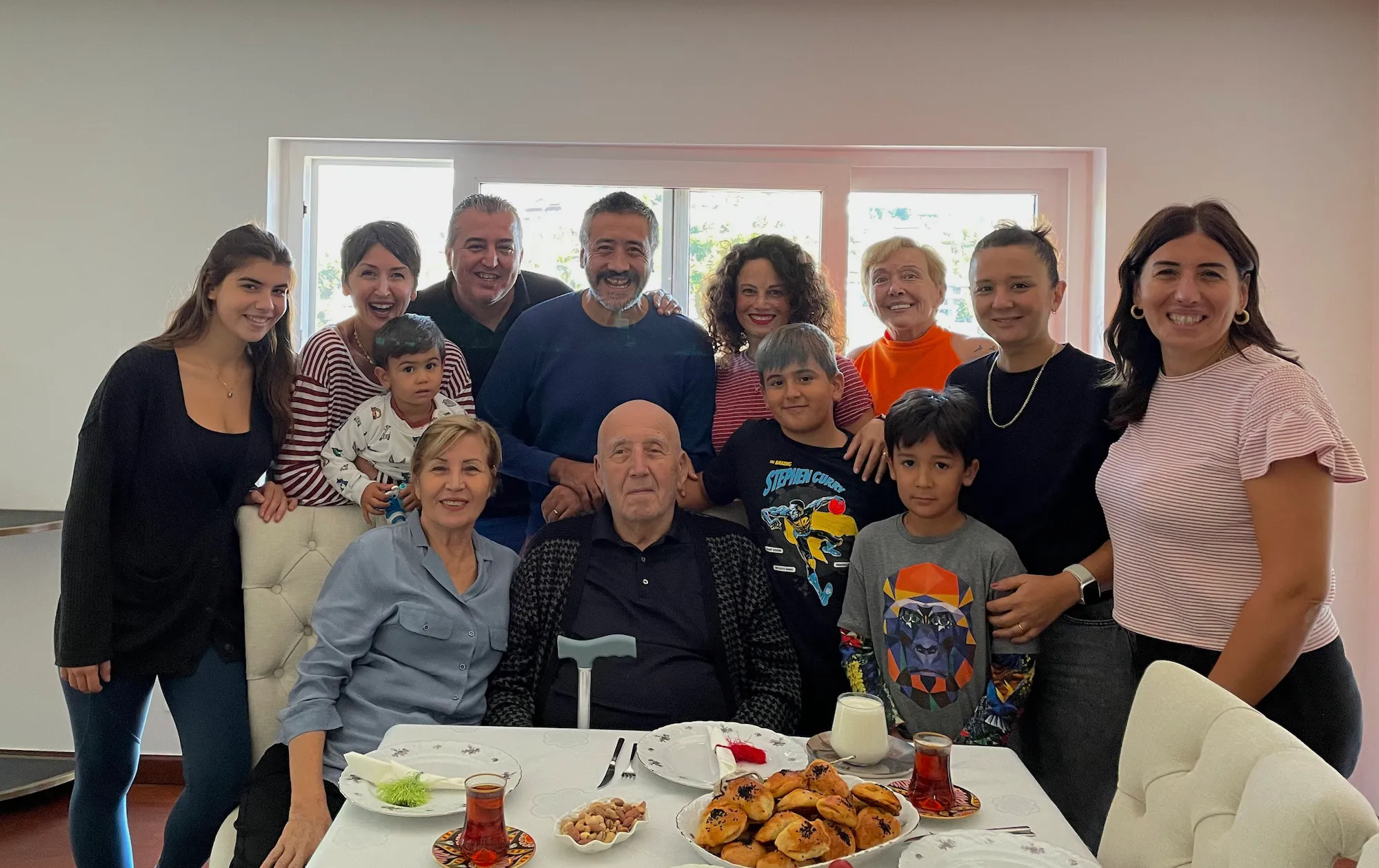
Sunday, 26 September 2021. A family breakfast get-together.